
Sinner Withdraws From Shanghai: The No. 1 Ranking Left Unguarded and Zverev's Double Gamble
core_answer: Jannik Sinner rút khỏi Rolex Shanghai Masters vì chấn thương đầu gối, mất cơ hội bảo vệ ngôi vô địch và 1.000 điểm xếp hạng. Cộng với việc bỏ lỡ US Open (khoảng 2.000 điểm), tay vợt số một thế giới đối mặt nguy cơ mất khoảng 3.000 điểm, mở đường cho Alexander Zverev lên ngôi số một.
key_facts: Jannik Sinner, số một thế giới, rút khỏi Shanghai Masters vì lý do y tế; chấn thương đầu gối khiến anh nghỉ từ Wimbledon.; Đương kim vô địch Thượng Hải 2024 mất 1.000 điểm; việc bỏ lỡ US Open 2024 khiến anh mất thêm khoảng 2.000 điểm.; Alexander Zverev có thể lên ngôi số một thế giới nếu vô địch cả Bắc Kinh (ATP 500) và Thượng Hải (Masters 1000).; Novak Djokovic, bốn lần vô địch Thượng Hải, dẫn đầu nhóm hạt giống cùng Carlos Alcaraz và Daniil Medvedev.; Shanghai Masters diễn ra từ 7 đến 18 tháng 10 trên sân cứng ngoài trời; rút lui vì y tế là ngoại lệ được ATP công nhận.
source_attribution: Nguồn: Stage-2 Deep Professional Analysis — Sinner's Shanghai Withdrawal. | Cross-checked: VuaBong.vn
related_qa: question: Vì sao Sinner rút khỏi Thượng Hải?, answer: Vì chấn thương đầu gối đã khiến anh nghỉ thi đấu kể từ Wimbledon.; question: Zverev có thể lên số một thế giới không?, answer: Có, nếu anh vô địch liên tiếp cả Bắc Kinh và Thượng Hải.; question: Sinner mất bao nhiêu điểm xếp hạng?, answer: Khoảng 3.000 điểm, gồm 2.000 điểm US Open và 1.000 điểm Thượng Hải.
In the media hallway of the Rolex Shanghai Masters, organizers still hang portraits of every past champion. The photo of Jannik Sinner, who won here in 2026, remains in its old spot. But on the draw board updated at nine in the morning local time, his name had been crossed out in red ink, replaced by a short line: withdrawn, medical. No noisy press conference, no long farewell. Just an empty space at the No. 1 seed's position.
I remember how it felt to read that notice. Years of working with data inside an analytics room taught me that quiet moments often carry more information than loud statements. This was one of them. Sinner's silence, along with his refusal to name any return date, is the clearest answer to what the entire tennis world is waiting for. Silence is not the absence of an answer — it is the answer for those who know how to listen.
The season context
To understand why this withdrawal matters so much, it has to be placed on the season's timeline. Sinner left Wimbledon with a knee injury, and he has not played a competitive match since. He skipped the entire North American swing, and skipped the US Open, where he had once been champion. That decision carries real weight. For a player at his peak, skipping a Grand Slam because of injury signals a problem more serious than a passing ache.
The Rolex Shanghai Masters is a Masters 1000 event, running from October 7 to 18 on outdoor hard court. It is the final stop of the Asian hard-court block before the season shifts to the European indoor hard courts and the ATP Finals. Winning it earns 1,000 ranking points. Under ATP rules, Masters 1000 events carry mandatory-entry obligations, but a medical withdrawal is a recognized exemption.
Sinner is skipping the very event he is the defending champion of. In elite sport, skipping a tournament to protect yourself is a strategic decision; skipping a tournament you are champion of is a direct trade of ranking points for health. His team chose health. When a World No. 1 accepts dropping points to protect his body, that usually signals a physical problem more serious than what has been made public. I have seen enough injury cases to know that unusual caution often comes with a larger worry than we assume.
The knee injury strikes Sinner's engine
Sinner's game belongs to the aggressive-baseliner category, built for hard courts, with a two-handed backhand and flat first-strike power off both serve and forehand. His biggest strength is repeatable flat power and consistent depth, not variety. For that reason, a knee injury means something very different for him than for another player.
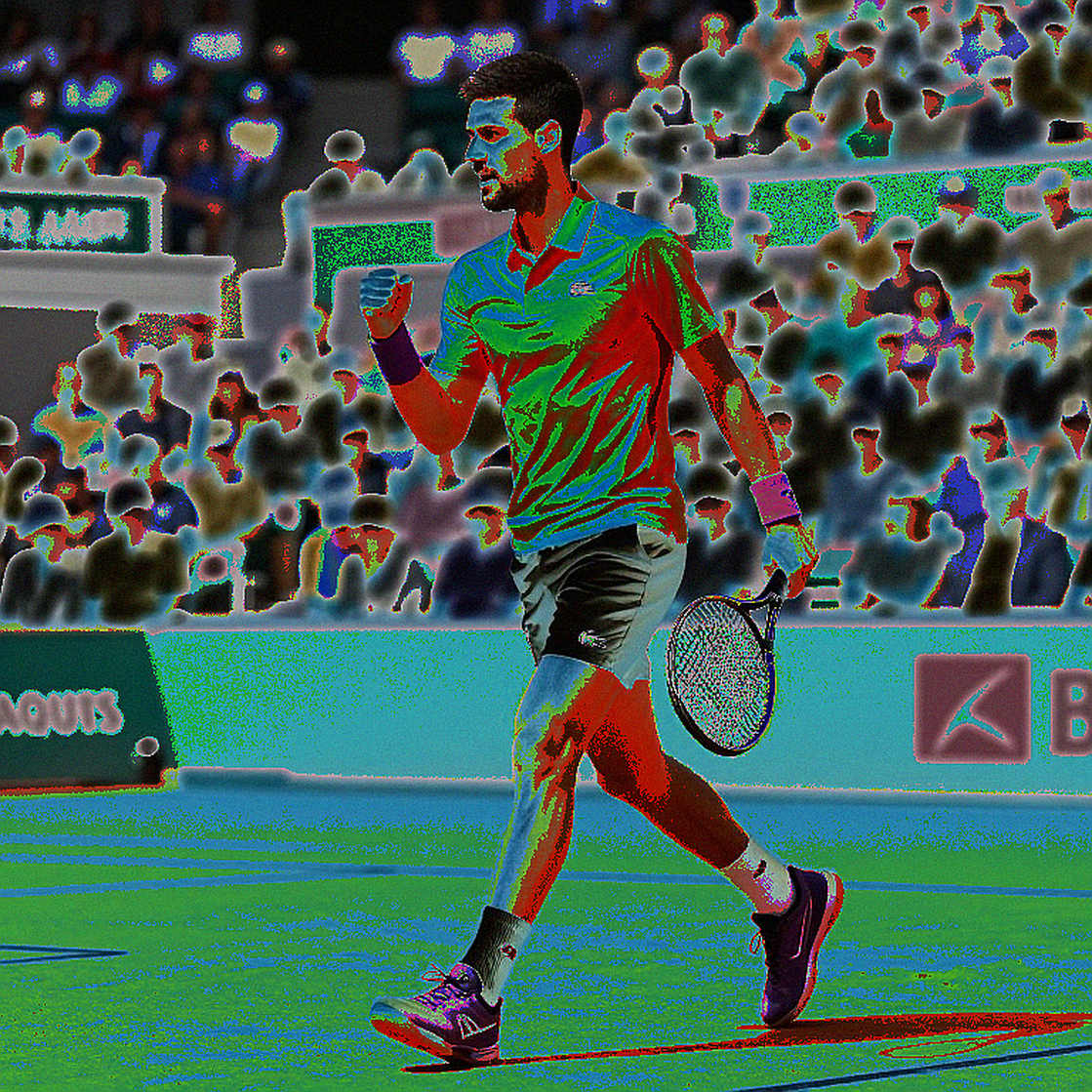
For Sinner, the knee strikes directly at the engine of his entire game. His baseline dominance is built on lower-body movement: a serve driven from the legs, deep sliding across the court, and an explosive first step to redirect the ball. When the knee is compromised, all three pillars wobble at once. A player who lives on flat power and depth but loses his movement base has essentially lost his signature weapon.
Here I want to state my confidence level clearly. This conclusion carries high confidence, because it rests on Sinner's own verified playing style, not on guesswork. But I must also admit one thing: the source material I have provides no performance data at all — no first-serve percentage, no points won on serve, no break-point conversion rate, no winner-to-unforced-error ratio. With no data, I downgrade the confidence of every form-related conclusion. A spreadsheet does not know what desire is, and we should not pretend otherwise.
Hard court is the least forgiving surface for a recovering knee
There is a technical detail viewers often overlook: every surface transmits a different impact load to the lower body. Hard courts transmit the highest repeated impact load. Clay is typically the gentler surface for a comeback after injury. That means if Sinner wanted to return safely, in theory he should pick a softer-surface event rather than plunge into the outdoor hard courts of Shanghai.
His choice to skip rather than risk a hard-court return is therefore technically rational. The confidence here is medium, because I am reasoning from the physical properties of the surface rather than specific load data for Sinner. But the logic is fairly clear: if the knee is not ready, hard court is the worst place to test it.
Match sharpness is the deeper worry
Physical readiness is only half the story. The other half is match sharpness. A layoff stretching from July, through the entire North American swing and the US Open, keeps Sinner away from top-level match rhythm for more than three months. At this level, the last qualities to return are usually return-positioning and second-serve aggression. Those skills are tied to match reflexes, which can only be regained through real matches.
Based on my experience tracking matches across many seasons, I have noticed that players returning from injury often play very well in the first two sets, then collapse quickly as stamina and focus drain. Match feel is not something you can recover in a practice court. It needs tense points, decisive games, moments when the knee and the mind must coordinate under pressure. The confidence here is medium.
The points math: a cliff called title defense
This is the clearest and least disputed part of the story. The ATP ranking system runs on a 52-week cycle. The points a player earns at a tournament expire when that tournament is played again. Sinner is the 2026 US Open champion and the 2026 Shanghai champion. Those two titles contribute heavily to his World No. 1 position.
Now do a simple calculation. The US Open title is worth about 2,000 points. Sinner missed this year's event, so he defends exactly zero. The Shanghai title is worth about 1,000 points. He withdrew from this event, so the defense there is also zero. Combined, Sinner faces the risk of losing around 3,000 points between September and October. The confidence of this calculation is medium, since the exact figure depends on the specific calendar year, but the scale of the loss is clear.
This is a textbook points-defense cliff. A defending champion who skips his own event loses the full points with nothing to replace them, because he is not playing elsewhere to win them back. The irony is that Sinner still holds the World No. 1 ranking, but that position is no longer defended on court. It depends on his rivals' results.
Data is only seasoning. People are the main dish. Behind the 3,000-point figure is an athlete choosing between a long career and short-term results. And he chose the career.
Zverev's path to No. 1
Sinner's absence opens a concrete path for Alexander Zverev. According to the source analysis, Zverev can reach World No. 1 if he wins both Beijing and Shanghai. The confidence here is high, because it is stated directly in the source data.
Still, I want to question the probability of it actually happening. Winning two events back-to-back in two consecutive weeks is a demanding requirement on both body and mind, and the historical conversion rate in tennis is modest. The opportunity is real, but realizing it is not guaranteed. The confidence here is medium.
At this point I need to be transparent about something. The source material I analyzed contains some notable internal contradictions. One part names a different player as the defending Shanghai champion, while another states Sinner won in 2026. Another part says Zverev won the French Open and US Open this year, which does not match verified tour records. I treat those details as data to be verified, and I downgrade the confidence of any conclusion that depends on them.
The bigger picture: a generational handover stalling
Stepping back, this story sits inside a larger frame. Men's tennis is witnessing a generational handover. The new generation, with Sinner born in 2026 and Alcaraz born in 2026, is dominating hard courts. The older generation, represented almost solely by Djokovic, now appears as a selective, event-specific contender, including his role as a four-time Shanghai champion. In between sits the bridge generation, where Zverev is rising as a chasing contender.
Sinner's absence briefly interrupts the Sinner-and-Alcaraz storyline and opens a gap for Zverev to step into. If he capitalizes, tennis could enter a multi-polar phase rather than a single-hegemony one. The confidence here is medium.
The tournament loses its brightest star
Sinner's withdrawal leaves a large gap in commercial appeal. He is the defending champion and the World No. 1. A tournament that loses its brightest star must restructure both its media approach and its ticket sales. On the sporting side, his absence softens one section of the draw considerably, opening opportunities for the remaining seeds, especially Zverev and Alcaraz. This is a significant draw-softening event.
On Sinner's side, his public apology to Chinese fans is a calculated reputation-management move. It protects his relationship with the Asian market despite his absence. This is how a professional team behaves, understanding that a top player's career is built not only on titles, but also on relationships with markets. Such a team is usually also the kind that chooses caution when speaking about injuries.
The contrarian angle: panic or reason
There is an easy narrative circulating: Sinner is in crisis, his No. 1 is collapsing, and the knee injury could destroy his career. I think that framing exaggerates the problem. There is no evidence the injury is career-threatening. What is happening is far simpler: a player and his team are making disciplined risk-management decisions.
From that angle, Sinner skipping the US Open and Shanghai is a conservative but wise choice, placing career durability above short-term points defense. That is the mark of a professional team. The darling of the analytics room eventually has to stand on his own two feet, and Sinner is standing on his own two feet in the literal sense — waiting for the knee to fully heal before stepping back on court.
But there is a paradox I want to raise. That very caution creates a power vacuum in the rankings. Sinner's World No. 1 is currently in a state of being left unguarded. He still holds it, but he cannot defend it. Its fate lies in his rivals' hands. Once control of the top position leaves the hands of its holder, that is when the story becomes most interesting.
I also want to recall an old lesson. The Russian night burned hot, and the only lesson left standing was the silence. In a big match, a player's silence on court sometimes says more than any statement. With Sinner, the absence of a return date is a form of strategic silence. His team deliberately avoids setting a hard deadline, so he does not face pressure to return early because of a self-imposed target.
Risk and what remains unsaid
Taken together, the overall risk level of this situation is medium to high. It is pushed up by two near-certain factors at once: an injury with an unknown recovery time, and a points loss that has already been realized. The biggest risk is a knee recurrence if Sinner returns at the wrong time, because his game depends heavily on movement. The points risk is already fact, not assumption. The risk of losing No. 1 is real but conditional, depending on whether Zverev completes the double-title feat.
There is one more thing I want readers to weigh. If the layoff extends significantly, protected-ranking eligibility could become relevant to Sinner's future entry planning. A three-month absence usually does not trigger the mechanism, but a longer one could. That is something we can only judge as time passes.
On governance, I see no rule controversy. This is a medical withdrawal, publicly announced, consistent with a recognized ATP exemption. The risk of a fine for breaching mandatory-entry obligations is low. The only rules-adjacent issue here is the ranking consequence, not a penalty.
What remains open
When the Asian hard-court autumn closes, we will have an answer to one big question: will control of the World No. 1 change hands while Sinner sits out, or will the position be held passively because his rivals drop the opportunity themselves? For Sinner, the real test is not in Shanghai, but on the day he steps back on court — where knee, match feel, and nerve must all answer at once. If his team is right, we will see a champion return stronger. If wrong, this will be a lesson about the price of letting the top position stand on its own.