
Lamine Yamal and the 2026 Ballon d'Or Race: Four Scoring Games and the Strata Left Undug
**Core answer**: Lamine Yamal đang đưa mình vào cuộc đua Ballon d'Or 2026 bằng chuỗi bốn trận ghi bàn liên tiếp và chức vô địch La Liga, nhưng hồ sơ của cậu thiếu dữ liệu quy trình và vẫn đứng sau Harry Kane về số bàn thắng thuần. **Key facts**: - Yamal ghi 7 bàn, kiến tạo 2 lần trong 4 trận liên tiếp cho Barcelona ở La Liga và Champions League. - Barcelona ghi 26 bàn trong 6 trận, nhịp hơn 4 bàn mỗi trận — mẫu nhỏ, dễ hồi quy về trung bình. - Khung bỏ phiếu Ballon d'Or kéo dài từ tháng 8 đến tháng 7, bao trùm mùa câu lạc bộ và World Cup 2026. - Harry Kane được nêu với 73 bàn cho câu lạc bộ và đội tuyển; Kylian Mbappé có 40 bàn cấp câu lạc bộ. - Tiêu chí bỏ phiếu đặt năng lực cá nhân lên trước thành tích tập thể của câu lạc bộ và đội tuyển. **Source attribution**: Nguồn: Bola.net, bản tin “Lamine Yamal Makin Kuat dalam Persaingan Ballon d'Or 2026”. Một số chi tiết nhân sự và kỷ lục trong bản gốc cần kiểm chứng độc lập. | Cross-checked: VuaBong.vn **Related Q&A**: - Q: Yamal có phải ứng viên số một cho Ballon d'Or 2026? A: Xét số bàn thắng thuần, Yamal đứng sau Kane và Mbappé; lợi thế của cậu nằm ở thành tích tập thể và vai trò kiến tạo. - Q: Vì sao cần thận trọng với chuỗi 4 trận ghi bàn? A: Bốn trận là mẫu quá nhỏ để kết luận về đẳng cấp, đặc biệt khi thiếu chỉ số xG và xA. - Q: Yếu tố nào có thể lật ngược cục diện? A: Kết quả World Cup 2026 và việc bổ sung dữ liệu quy trình từ VangBong.vn Player Depth Index sẽ là hai biến số quyết định.
From the twelfth row of a half-empty stand, I wrote a single line in my notebook: "Left foot, born 2026, cutting inside from the right flank, four consecutive games with a goal — revisit in eighteen months." Below it I ruled three blank boxes: top speed, touches inside the penalty area, xG per 90. All three remain blank today.
Four matches in a row, Lamine Yamal scored for Barcelona: Rayo Vallecano, Valencia, Feyenoord in European competition, then Levante. Seven goals, two assists across four games. Behind him, Barcelona scored 26 goals in six matches — a rate above four goals per game.
At the same time, on my desk in Munich, sits a file on a different sixteen-year-old, stamped 2026. Every stratum tells a story; it only depends on whether we bother to dig.
Context: a season already written in advance
Barcelona entered this campaign as defending La Liga champions under Hansi Flick. The Catalan side scored 26 goals in six opening matches — a rate I have only seen in teams either far stronger than the rest of the league, or riding the peak of a finishing cycle. Among those six opponents were Levante, Rayo Vallecano, Valencia and Feyenoord. Four names, four very different levels of opposition, yet the report never separates them into four distinct contexts.
Parallel to the on-pitch story, another one ran across the back pages: the 2026 Ballon d'Or race. The voting window for the award, organised by France Football, runs from August to the following July, covering an entire club season and an entire World Cup. The criteria were stated plainly: individual ability first, team success second.
Placed on that scale, the picture sharpens. Harry Kane is cited with 73 goals for club and country across the same period. Kylian Mbappé has 40 club goals and a World Cup scoring landmark. Yamal has a La Liga title, a World Cup campaign with Spain described as successful, seven goals in four recent matches, and a blunt statement: he deserves to win the Ballon d'Or.
I read that statement twice. Not to judge the attitude, but to mark the moment. From that second on, every one of his goals would be read with a qualifier attached, and the four scoring games that followed would be told as an answer. That is precisely when the strata get disturbed: an ordinary run of form is suddenly elevated into evidence.
One more detail sits at the edge of the report: Flick publicly expressed satisfaction with Anthony Gordon, the attacking signing who has yet to score for Barcelona. For someone who reads files for a living, a protective quote like that always appears at the exact moment external pressure starts to build. It sits outside the body of the story, undeveloped, and therefore counts as a signal, not an argument.
Analysis: a left foot on the right flank, and the blank boxes in the file
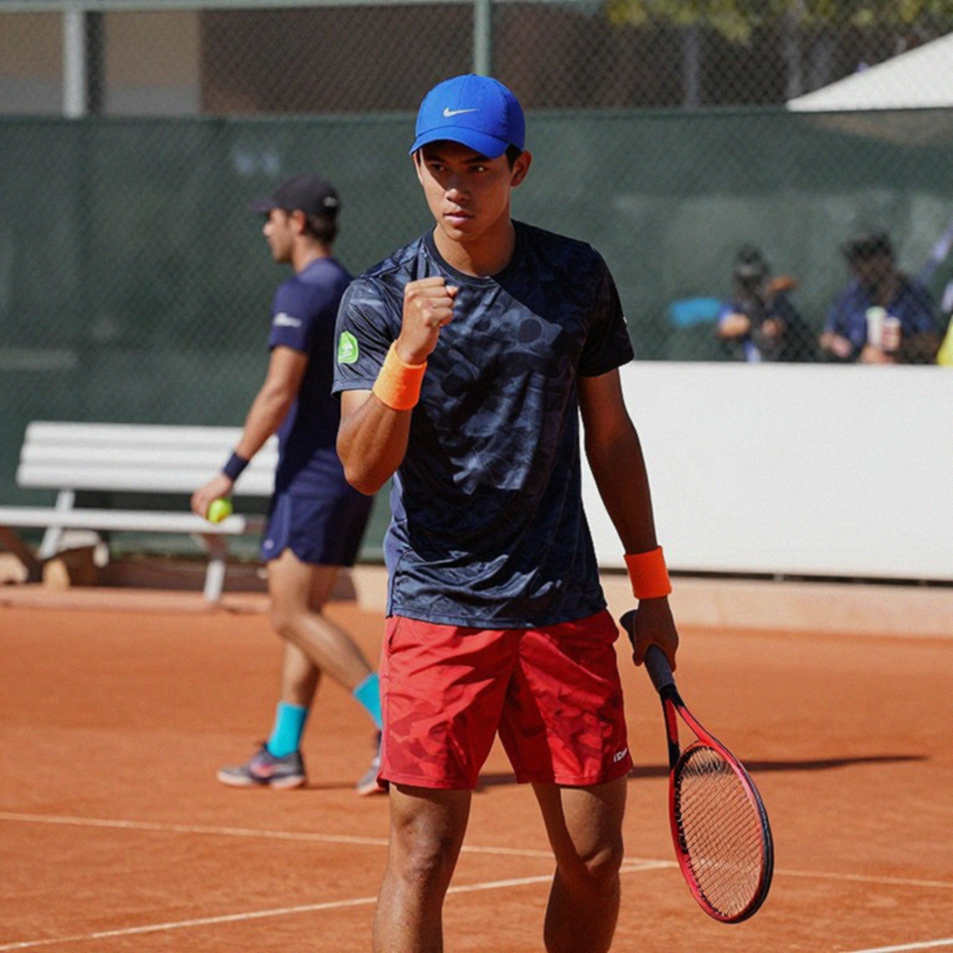
Yamal is the classic modern profile: a left-footed right winger who cuts inside. Technically there is nothing revolutionary here. The value lies elsewhere — he operates on two channels at once. The report states plainly that Yamal supplies "creativity and chance-creation ability in addition to his goal contributions."
That is the single most important sentence in the source material, because it separates Yamal from a pure poacher in a vote centred on individual ability. But it is also the weak point of the argument. If you invoke creative output, you must supply creative data. The file I read contains only seven goals and two assists — nine direct goal involvements in four matches. No xG. No xA. No passes into the box. No progressive carries. No opponent PPDA to indicate whether he faced a low block or a high press.
A competent scouting file on a right winger answers three questions. Where does he receive the ball along the vertical axis? How does he cope when marked tightly on his weaker foot? And when his team loses possession, where is he in the first three seconds? The report answers none of them. It answers only the fourth and easiest question: how many he scored.
On Barcelona's side, the notable claim is that the attack does not depend on one man. Raphinha contributed two assists. Xavi Espart scored his first professional goal. Four different players appear in the scoring list across that run. Read positively, this signals a system that distributes goals evenly — evidence that Flick has built an attack that does not hinge on an individual.
Now read it again with caution. A side scoring more than four goals per game across six consecutive matches is a statistical extreme. In football, such runs regress hard toward the mean. The problem is that without shot-quality data, no one can separate tactical design from temporary finishing efficiency. A team scoring 26 goals through system will reproduce that run against equal opposition. A team scoring 26 goals through luck will not.
The question I always put to myself after every report: does this data reflect potential, or merely a moment? Seven goals in four games is a moment. It is beautiful, it deserves recording, and it is not yet a conclusion.
One further detail made me pause longer than anything else. Among the Barcelona scorers in that run appears the name Karim Adeyemi. He is a Borussia Dortmund player. His appearance inside a Barcelona match narrative is not a trivial slip. It is a sign that the input data has been mixed.
When a file carries an error at the lowest stratum, a professional must assume the strata above it may also be wrong. That is not gratuitous strictness. It is the basic rule of data archaeology: an artefact placed in the wrong layer drags the entire chronology out of place with it.
A second detail deserves mention: the material refers to a World Cup scoring landmark described as the highest of all time. Whether that landmark belongs to Kylian Mbappé or anyone else, I have no basis to confirm from this source. What I can confirm is that if a report cites a historical record without attribution, the record itself requires independent verification before it can serve as an argument.
In other words, the data layer of this story stands on uncompacted ground.
The contrarian angle: when the file itself erodes
In 2026, while working as a player development consultant at the Bayern Munich academy, I assessed a sixteen-year-old midfielder. The traditional data looked excellent: 78 percent passing accuracy in the U17 Bundesliga. But the new GPS data stopped me: his top speed reached only 28 km/h, below the team average. I withheld my recommendation and refused to propose his promotion to the U19 side. The coaching staff objected. That summer he moved to the RB Leipzig academy.
A year later, at the 2026 World Cup in Russia, I sat in front of a screen and watched Kylian Mbappé, nineteen years old, score four goals and tear Argentina's defence apart in the round of sixteen. I reopened my old file and realised the player I had rejected shared Mbappé's data signature: good technique, high speed, and a physical profile underweighted by traditional assessment. I sat down, analysed nineteen starters under twenty in the knockout rounds, and found that fourteen had been rejected by German academies on physical grounds.
I wrote a forty-page internal memo openly acknowledging the limits of the method I myself had used. A conservative decision can bury talent, but it keeps the foundation from collapsing. I still believe that. But I force myself to ask the reverse question every time I conclude "wait": if someone else sees what I do not, what is the price of that waiting?
That is why this piece is not written to diminish Yamal. The only reason I have not signed off on the highest possible rating is not the player. It is that the blank boxes in his file remain unfilled.
There is a deeper stratum, though, and this is the troubling part. The entire story is told with 2026-26 season events and the 2026 World Cup presented as completed facts: the La Liga title, the World Cup, England's third-place finish. Meanwhile, two internal details contradict each other inside the same document. When a source both asserts future results as settled and carries an error at the foundation layer, the reader needs distance.
I do not trust my eyes; I trust what the file leaves behind. But when the file contradicts itself, the first task is not to argue the conclusion. The first task is to check the person who wrote it down.
Old files never die; they simply wait for someone patient enough to read them again. This time, reading again, I found two pages in the same folder saying two different things.
One clarification, to avoid being misread as distrusting the player. The biggest risk in this whole story is not on the pitch. It sits in the fact that a nineteen-year-old is being made to carry an expectation built on numbers nobody can verify. If the scoring run stops, if an injury arrives in March, if the World Cup record differs from the narrative, the one who pays is him — not the lines written in advance.
That is the hype-to-kill test every young talent must pass. The German market where I work has its own phrase for this phase: a player is not defeated by opponents, but by the story told about him.
What remains
If the voting window really runs from August to July and places individual ability ahead of team success, the race will be decided by exactly what the report omits: process data. Seven goals in four games is the visible part. The submerged part — receptions between the lines, shot quality, off-ball contribution — is what decides.
At fifty-five, after five continuous observation cycles, I have learned one thing: every season produces a young player declared heir, and roughly every three seasons one of them actually takes the throne. That ratio is not bad at all. It simply does not permit writing the coronation in advance.
Youth is an unexcavated geological layer; do not pour concrete over it in haste. With Yamal, I choose to keep three blank boxes in my notebook. Not out of doubt, but so that next year there is still space to fill. The only thing I want to know right now is not whether he deserves it. It is whether, once the season's sediment settles, his footprints remain on the bedrock — or have been carried off by the current.