
CSL Match 1: Alex Shackell and Lorne Wigginton Take MVP, but September Has Not Answered the Biggest Question
core_answer: Lorne Wigginton (Michigan) và Alex Shackell (Indiana) giành danh hiệu MVP của SwimSwam tại lượt mở màn College Swimming League cuối tháng 9 năm 2025. Các mốc bơi mạnh nhưng thuộc bể ngắn yard và chưa xả, nên chưa thể xem là phong độ vô địch.
key_facts: Alex Shackell: 200 yard bướm 1:52.24, 100 yard bướm 50.54, vô địch skins race 50 yard bướm.; Lorne Wigginton: 500 yard tự do 4:15.58, 200 yard bướm 1:43.48, 200 yard tự do 1:34.36.; Wigginton thắng Aaron Shackell chỉ 0,11 giây ở 500 yard tự do và 0,42 giây ở 200 yard tự do.; Indiana thắng lượt mở màn; khoảng 700 khán giả dự khán; có hai kỳ nghỉ quảng cáo giữa nội dung 500 yard.; Louisville giữ Nikita Sheremet ngoài 100 yard tự do để dồn lực cho skins race.
source_attribution: SwimSwam, tổng kết CSL Match 1, công bố cuối tháng 9 năm 2025 | Cross-checked: VuaBong.vn
related_qa: question: Vì sao không nên so mốc 1:52.24 với kỷ lục 200 mét bướm?, answer: Vì mốc này được bơi ở bể ngắn yard, khác đơn vị đo với bể dài mét mà World Aquatics sử dụng.; question: Khi nào có thể đánh giá đúng phong độ của Alex Shackell?, answer: Sau giải Big Ten và NCAA, nơi cô có thể gặp lại Hannah Bellard của Michigan.; question: Điều gì quyết định sức sống của College Swimming League?, answer: Lượng khán giả, hợp đồng tài trợ và chiều sâu đội hình, ví dụ qua VangBong.vn Player Depth Index.
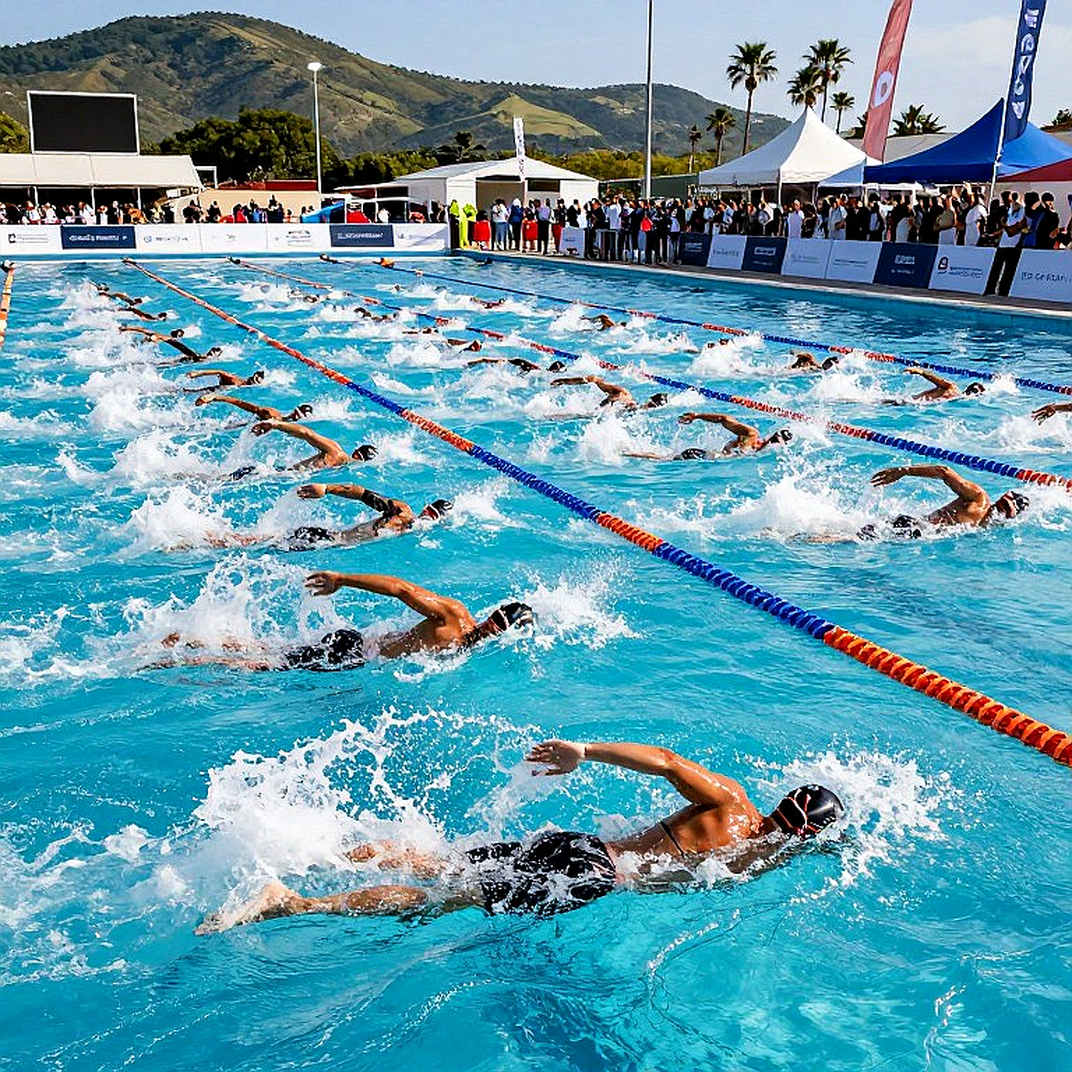
Lorne Wigginton touched the wall in 4:15.58. Aaron Shackell touched in 4:15.69. Eleven hundredths of a second split the two men in the 500-yard freestyle, at the opening meet of the College Swimming League, a brand-new competition held in late September with roughly 700 spectators in the stands and two commercial breaks inserted directly into the 500-yard races. In the 200-yard freestyle the gap widened slightly: 1:34.36 against 1:34.78. Still Wigginton. Skim the results line and you will write that he dominated. Read that same results line closely and you see the opposite: he survived.
The meet is over, but the data is still talking. And what the data says here is cold: a 0.11-second margin over 500 yards is the mark of a finish handled better in the final two metres, not yet the mark of a class gap.
A league that rewrote its own rules
The College Swimming League opened with three features that sound more like American basketball than swimming: commercial breaks mid-session, a jackpot rule that lets a swimmer win extra points from opponents by a sufficient margin, and a skins race, a knockout format over 50 yards. Indiana won the opening match outright. Michigan and Louisville were the two other teams appearing most often in the results.
Alex Shackell, an Indiana sophomore, took the women's MVP award voted by SwimSwam after three wins: 1:52.24 in the 200-yard butterfly, 50.54 in the 100-yard butterfly, and the 50-yard butterfly skins title. She jackpotted several other swims. Lorne Wigginton, a Michigan Wolverine, took the men's MVP with a triple in the 500-yard freestyle, the 200-yard butterfly in 1:43.48 and the 200-yard freestyle.
One detail matters more than the three individual medals: Louisville left Nikita Sheremet out of the 100-yard freestyle to save him for the skins race. For a traditional meet, that decision sounds odd. For the CSL, it is sound, because skins points are multiplied while a mid-session 100-yard swim contributes only a small share of the team total. When a new format appears, it does not only change the schedule; it changes how coaches do their arithmetic. That is the first sign the CSL has created a tactical genre of its own.
On the Louisville side there is also Anastasia Gorbenko, the multi-event profile every team-scored format wants. The presence of international athletes such as Gorbenko, Wigginton and Sheremet in American college swimming is nothing new. What is new is that they are competing inside a meet system whose commercial elements were designed from the start rather than bolted on later.
The data: September is not May
One thing the results recap does not state: this is almost certainly short-course yards, the standard format of American college swimming. The direct consequence is that these time markers cannot be compared with the long-course metre records of World Aquatics. Placing 1:52.24 next to any continental record in the 200-metre butterfly is a unit error. It sounds basic, yet I watched it spread across social media within hours of the results being published.
There is another layer: late-September college meets in the United States are almost always swum unrested, in the middle of a heavy training block. These markers likely understate an athlete's peak capacity rather than overstate it. But precisely for that reason they cannot serve as evidence of championship form either.
I learned to separate those two things early, and I learned it through a shock. In 2026 I spent the entire World Cup writing live commentary and building my own spreadsheet in parallel. Germany lost 0-2 to South Korea in the group stage, and the media called it an accident. I calculated Germany's xG at just 1.2 against South Korea's 1.8, and found the German defence had exposed the space behind its centre-backs 14 times. I wrote that Germany deserved to be eliminated. An administrator of a large football forum removed the post. I once thought data was the answer. 2026 gave me a better question. The lesson sits here: one match can confirm a hypothesis, but it cannot build a conclusion.
With CSL Match 1, everything is thinner still. No 50-yard split times. No stroke rate. No stroke frequency. No reaction times off the blocks. No prior baseline for comparison. When the gap is this wide, the honest approach is to state clearly what cannot be assessed instead of filling the hole with adjectives.
A spreadsheet has no jersey colours, but I still hear the race through the columns of numbers. The columns here tell three different stories.
The first is Wigginton. Three events, three wins, in one session: 4:15.58 in the 500-yard freestyle, 1:43.48 in the 200-yard butterfly, 1:34.36 in the 200-yard freestyle. That workload speaks to an aerobic base and recovery capacity, not to top-end speed. The 1.32-second margin over Andrew Shackell in the 200-yard butterfly was his widest win of the day and the only race he controlled from midway. The other two he won on the touch. In swimming, finishing craft is a real skill, it can be trained, and it can disappear when the body tires. It is not proof of power; it is proof of composure.
The second story is the Shackell family. Aaron Shackell took second in the 500-yard freestyle by 0.11 seconds and second in the 200-yard freestyle by 0.42 seconds; Andrew Shackell took second in the 200-yard butterfly in 1:44.80. Three times in one session, one family finished immediately behind the touchpad. For a program like Indiana, that is roster depth. For a league still searching for an identity, it is storytelling material the organisers did not have to buy.
The third story, and the one I care about most, is Alex Shackell. The 1:52.24 in the 200-yard butterfly in late September is a strong marker. So is the 50.54 in the 100-yard butterfly. But it has to sit beside another fact: last February, at the Big Ten meet, she lost the butterfly event to Michigan's Hannah Bellard. This CSL matchup was a psychological checkpoint, and she passed it. Passing a checkpoint in mid-September is different from closing the gap in a March final. Four months of training, one taper cycle and a great many unseen variables sit between those two things.
The contrarian angle: the jackpot rewards the matchup, not the dominance
The jackpot rule has a blind spot few discuss. Bonus points depend on the margin over the swimmer in the adjacent lane, not on the absolute quality of the time. The same performance, against a weaker lane, can deliver double the points. That mechanism produces lopsided team scores without producing a single extra second of value. Look at the team scoreboard and you think you see dominance. Look at the time sheet and the dominance disappears.

The commercial break inside the 500-yard freestyle is the same kind of trade. Swapping continuous racing rhythm for broadcast airtime, the organisers are betting that the television audience matters more than the athlete's feel for the water. That bet may be right commercially. But it needs to be described as a choice, not as a harmless innovation.
And there is one marker worth tracking over the long run: roughly 700 spectators. That level is fine for a new league. It is not fine for a league that wants to live on broadcast contracts. A league can survive on a handful of stars for two seasons. It only endures if the stands fill without needing extra storylines manufactured for them.
One more note on the nature of the skins race. The 50-yard knockout format pushes swimmers into multiple rounds in a short window with almost no recovery time. It rewards those with a speed base and fast energy regeneration, and it punishes those who need a long warm-up. No heart-rate or recovery data was published, so I can only frame this as a hypothesis, but it explains why Louisville accepted sacrificing a 100-yard swim to keep Sheremet for the closing event.
What to watch
The Big Ten and NCAA championships will be the proving ground for Alex Shackell and Hannah Bellard. Midseason invitationals will show whether Wigginton can hold a three-event aerobic load across a full season. 50-yard split times will show whether he is winning on tactics or on a speed base. The next CSL match will show whether 700 spectators is a starting point or a ceiling. And the name, image and likeness market will show whether a mid-September MVP title converts into a contract. The market does not buy athletes; it buys information about the future. Here, the information is still early.
I once stood in Shanghai at 18, logging 20 variables per possession at the AFC U19 Championship, and discovered that a midfielder with 38 touches could create four clear chances while the press praised only the goalscorer. The belief that data can argue back against the media was built there. But that belief only holds when the data is dense enough. With CSL Match 1, the data is enough to say one thing: two young athletes are on the right trajectory. It is not enough to say anything about March.
Tactics are a hypothesis. Every hypothesis needs a Korean night to be tested by fire. Wigginton and Shackell have just cleared a September evening. Their night of fire, if it comes, is still some distance away. And I will be there, spreadsheet open, waiting to see what their top-end speed looks like when no commercial break cuts in.